
The Ratkai Case - Part II
The infamous Newfoundland Espionage Files

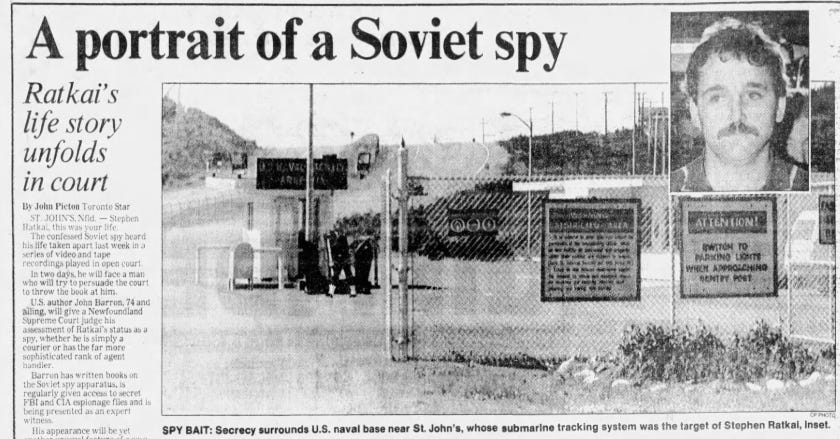
When I first wrote about the Ratkai espionage case, it felt almost cinematic, but in a restrained way. Naval Station Argentia. SOSUS. The Americans. A double agent.
Ratkai was a Hungarian engineering student known in court as Stephen Ratkai and within the operation as “Michael.” He later entered a guilty plea in the Supreme Court of Newfoundland on February 6, 1989.
Catch up on Part I:

The “Research Vessel” in St. John’s Harbour
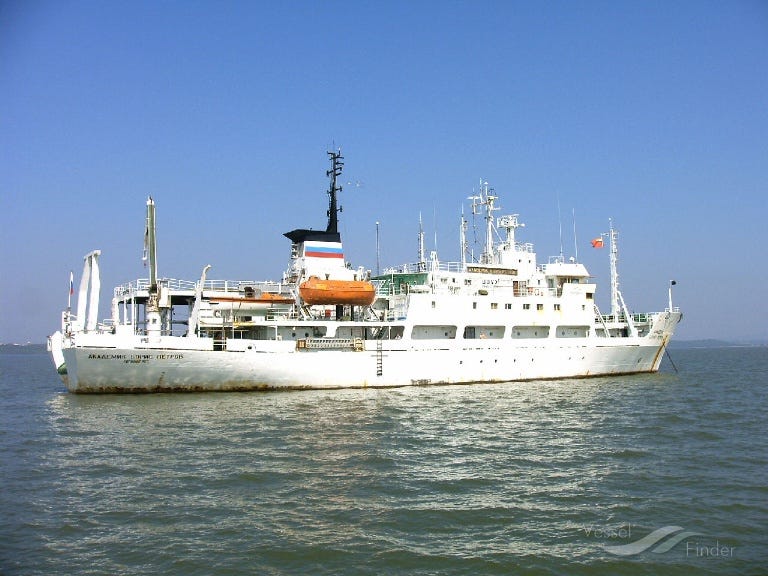
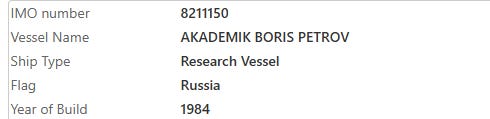
In December 1986, the Soviet research vessel Akademik Boris Petrov tied up in St. John’s Harbour. Officially, she was conducting oceanographic research, seafloor mapping, acoustic studies, and data collection in the North Atlantic.
But the Atlantic in the late 1980s was not neutral water.
Just down the coast stood Naval Station Argentia, one of the listening nodes in the submarine detection network used to track Soviet nuclear submarines beneath the North Atlantic. Acoustic research and submarine warfare were deeply intertwined. Understanding how sound travelled through thermal layers and seabed composition directly affected detection capability.
And that was the vessel Donna Geiger boarded.
Geiger was a Naval Investigative Service agent operating undercover. She walked up the gangway in St. John’s Harbour and stepped onto a Soviet research vessel during the Cold War. Known for being intelligent and quick-thinking under pressure, Geiger’s personal circumstances added further complexity and her husband was a civilian engineer at Naval Station Argentia, and she became pregnant during the sting operation.
When Geiger boarded the ship offering to sell information, she was introduced to two men who identified themselves as the captain and first mate. She gave them the number of a post office box she had already established for clandestine correspondence: P.O. Box 13673, Station A, Kenmount Road, St. John’s, NL.
The captain asked pointed questions such as her serial number, her rank (twice), where she was based, and the type of information she could access. He attempted to give her a small jar of caviar and offered a wooden spoon carved with Russian writing, both of which she declined. He later told her he would radio an offer and that someone would be in touch.
Later, Geiger received twelve letters from her “spymaster,” all mailed from either Ottawa or Montreal, where the Soviets maintained diplomatic presence. Linguistic analysis later established that the letters had been translated into English from Russian.
One letter read:
Dear Donna,
Thank you for your letter and I will be glad to get such warm letters in the future and hope to see you in March or April after I have been to sea.
Love, Peter
That meeting opened the channel that would eventually lead to Ratkai.
Interestingly, it was noted in October 2025 that the Akademik Boris Petrov had zigzagged in waters north of a German naval exercise area. The article noted that while the ship is registered as a research vessel operated by the Shirshov Institute of Oceanography, it is widely known for involvement in intelligence activities.
Russia’s so-called shadow fleet are hundreds of aging vessels registered under dubious circumstances to evade sanctions by illegally transporting oil and gas and has come under increased scrutiny following sabotage incidents in the Baltic Sea.
In October 2022, The Sun reported that the British Royal Navy was tracking a Russian “research” ship after it changed course off the UK coast amid fears of undersea cable sabotage. The Akademik Boris Petrov was diverted days after the Shetland Isles experienced a phone and internet blackout caused by severed seabed cables. The vessel later diverted north of Scotland following a mysterious passage near Norwegian airfields.
